
module Cat.Displayed.Isofibration.Free where
Displayed categories from functors🔗
The construction presented in this page is adapted from Foundations of Relative Category Theory.
module _
  {ob ℓb oe ℓe}
  {B : Precategory ob ℓb}
  {E : Precategory oe ℓe}
  (P : Functor E B)
  where
  private
    module P = Cat.Functor.Reasoning P
    module E = Precategory E
    open Cat.Reasoning B

  open Displayed
  open Functor
This page addresses the problem of comparing notions in the theory of displayed categories, as we have formalised it, with those in the traditional study of relative category theory, which are stated in terms of a projection functor Essentially, we want to replace with the total category of some displayed category so as to recover (up to equivalence) as the projection functor
Fixing a functor we define the type of objects over to consist of pairs where and — in other words, the objects over are not the type-theoretic fibre of over but instead the category-theoretic essential fibre of over
  Free-isofibration : Displayed B (ℓb ⊔ oe) (ℓb ⊔ ℓe)
  Free-isofibration .Ob[_] x = Essential-fibre P x
To understand the types of maps in we will diagramatically denote a pair as a “leg”
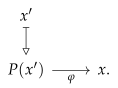
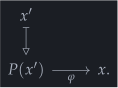
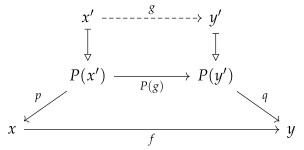
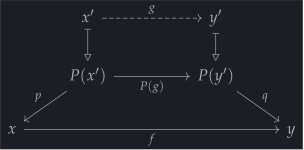
A morphism lying over is a map which, “over” the Isomorphisms and gets sent by to Pictorially, we understand the type of as that of dashed arrows in the diagram below, where the “leg” on the left (resp. on the right) is drawn with towards the screen.
  Free-isofibration .Hom[_] f (x' , p) (y' , q) =
    Σ[ g ∈ E.Hom x' y' ] q .to ∘ P.₁ g ≡ f ∘ p .to
The operations (identities and composition) necessary to make
a displayed category are inherited from those in
with commutativity of the diagrams defining them assured by
functoriality of
The displayed category laws are directly inherited from
  Free-isofibration .Hom[_]-set f a b = hlevel 2

  Free-isofibration .id' = record where
    fst = E.id
    snd = P.elimr refl ∙ introl refl

  Free-isofibration ._∘'_ (f , φ) (g , ψ) = record where
    fst = f E.∘ g
    snd = P.popl φ ∙ extendr ψ

  Free-isofibration .hom[_] p (f , α) = record
    { fst = f
    ; snd = α ∙ car p
    }
  Free-isofibration .coh[_] _ _   = Σ-prop-pathp! refl
  Free-isofibration .idr'   _     = Σ-prop-pathp! (E.idr _)
  Free-isofibration .idl'   _     = Σ-prop-pathp! (E.idl _)
  Free-isofibration .assoc' _ _ _ = Σ-prop-pathp! (E.assoc _ _ _)
module _
  {ob ℓb oe ℓe}
  {B : Precategory ob ℓb}
  {E : Precategory oe ℓe}
  (P : Functor E B)
  where
  private
    P∙ = Free-isofibration P

    module Iso[P] = Cat.Displayed.Morphism P∙
    module P = Cat.Functor.Reasoning P
    module B = Cat.Reasoning B
    module E = Cat.Reasoning E


  open Displayed-functor
  open Isofibration
  open Functor
  open Lifting
As an isofibration🔗
The construction of a displayed category from a functor results in an isofibration, and indeed this is the isofibration over freely generated by in a suitable bicategorical sense.
To show this, we will first need a technical lemma stating that an
isomorphism
in
whose forward direction extends to a morphism
over the forward direction of an isomorphism
extends to a complete isomorphism
in
  Free-isofibration-iso
    : ∀ {a b x y}
    → {u : a B.≅ b} {φ : P.₀ x B.≅ a} {ψ : P.₀ y B.≅ b} (θ : x E.≅ y)
    → ψ .to B.∘ P.₁ (θ .to) ≡ u .to B.∘ φ .to
    → (x , φ) Iso[P].≅[ u ] (y , ψ)
The details of the proof are not particularly interesting.
  Free-isofibration-iso {u = u} {φ} {ψ} θ p =
    Iso[P].make-iso[ u ]
      (θ .to   , p)
      (θ .from , q)
      (Σ-prop-pathp! (θ .invl))
      (Σ-prop-pathp! (θ .invr))
    where abstract
      q : φ .to B.∘ P.₁ (θ .from) ≡ u .from B.∘ ψ .to
      q = flip Equiv.from refl $
        φ .to B.∘ P.₁ (θ .from) ≡ u .from B.∘ ψ .to     ≃⟨ B.post-invl (B.iso→invertible u) ⟩≃
        u .to B.∘ φ .to B.∘ P.₁ (θ .from) ≡ ψ .to       ≃⟨ ∙-pre-equiv (B.extendl p) ⟩≃
        ψ .to B.∘ P.₁ (θ .to) B.∘ P.₁ (θ .from) ≡ ψ .to ≃⟨ ∙-pre-equiv (B.intror (P.annihilate (θ .invl))) ⟩≃
        ψ .to ≡ ψ .to                                   ≃∎
With this in hand, showing that is an isofibration is extremely straightforward. Supposing we have an iso and drawing the object we want to lift as a “leg”, we note that the lifting problem we have to solve involves a sequence of maps
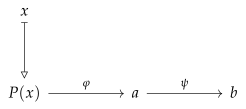
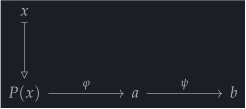
whence it is immediate that the lifting we desire is
  Free-isofibration-is-isofibration : Isofibration P∙
  Free-isofibration-is-isofibration = record where
    _^*_ ψ (x , φ) = x , ψ B.∘Iso φ
    ^*-lifts ψ (x , φ) = Free-isofibration-iso
      E.id-iso
      (P.elimr refl)
The total category🔗
There is an evident lifting of against which sends an object to the pair
  Free-isofibration-lifting : Lifting P∙ P
  Free-isofibration-lifting .F₀'  x   = x , B.id-iso
  Free-isofibration-lifting .F₁'  f   = f , B.id-comm-sym
  Free-isofibration-lifting .F-id'    = Σ-prop-pathp! refl
  Free-isofibration-lifting .F-∘' f g = Σ-prop-pathp! refl
Taken as a functor E→∫ from
this lifting extends to an equivalence of categories.
  private
    E→∫ : Functor E (∫ P∙)
    E→∫ = Lifting→Functor _ Free-isofibration-lifting

  Free-isofibration-lifting-split-eso : is-split-eso E→∫
  Free-isofibration-lifting-is-ff     : is-fully-faithful E→∫
The proofs are, again, straightforward functoriality reasoning.
E→∫ from
this lifting extends to an equivalence of categories.Free-isofibration-lifting-split-eso (b , x , φ) = record where fst = x snd = iso[]→total-iso _ {x≅y = φ} $ Free-isofibration-iso E.id-iso $ B.cdr P.F-id Free-isofibration-lifting-is-ff = is-iso→is-equiv λ where .is-iso.from h → h .snd .fst .is-iso.rinv h → ∫Hom-path _ (B.introl refl ∙∙ h .snd .snd ∙∙ B.elimr refl) (Σ-prop-pathp! refl) .is-iso.linv h → refl
Finally, as desired, precomposition with this equivalence takes the projection functor to 1
  Free-isofibration-recovers : πᶠ P∙ F∘ E→∫ ≅ⁿ P
  Free-isofibration-recovers = Lifting-nat-iso _ _ ni⁻¹
Freeness as an isofibration🔗
To show that is freely generated as an isofibration over by we show that any lifting of some other isofibration against can be re-expressed as a vertical functor
  Free-isofibration-factor
    : ∀ {oh ℓh} {H : Displayed B oh ℓh}
    → Isofibration H → Lifting H P
    → Vertical-functor P∙ H
  Free-isofibration-factor {H = H} H-isofib F = F† where
    open Cat.Displayed.Reasoning H
    module H = Isofibration H-isofib
    module F = Lifting F renaming (F₀' to ₀' ; F₁' to ₁')
The gist of the construction is presented below. Starting with an object we obtain an which we can transport to our desired since is an isofibration.
    F† : Vertical-functor P∙ H
    F† .F₀' (x , φ) = φ H.^* F.₀' x
    F† .F₁' {a' = x , φ} {b' = y , ψ} (h , p) =
      hom[ B.pulll p ∙ B.cancelr (φ .invl) ] (H.π* ∘' F.₁' h ∘' H.ι!)
Verifying that this assignment is functorial boils down to a straightforward calculation, using functoriality of the lifting
    F† .F-id' {x' = x , φ} = begin[]
      hom[] (H.π* ∘' F.₁' E.id ∘' H.ι!) ≡[]⟨ unwrap _ ⟩≡[]
      H.π* ∘' F.₁' E.id ∘' H.ι!         ≡[]⟨ refl⟩∘'⟨ eliml[] _ F.F-id' ⟩≡[]
      H.π* ∘' H.ι!                      ≡[]⟨ H.^*-lifts _ _ .invl' ⟩≡[]
      id'                               ∎[]

    F† .F-∘' {a' = x , φ} {b' = y , ψ} {c' = z , θ} {f' = f , p} {g' = g , q} =
      let
        open _≅[_]_ (H.^*-lifts φ (F.₀' x)) renaming (from' to φ^*→; to' to φ^*←)
        open _≅[_]_ (H.^*-lifts ψ (F.₀' y)) renaming (from' to ψ^*→; to' to ψ^*←)
        open _≅[_]_ (H.^*-lifts θ (F.₀' z)) renaming (from' to θ^*→; to' to θ^*←)
      in begin[]
        hom[] (θ^*← ∘' F.₁' (f E.∘ g) ∘' φ^*→)                           ≡[]⟨ unwrap _ ⟩≡[]
        θ^*← ∘' F.₁' (f E.∘ g) ∘' φ^*→                                   ≡[]⟨ refl⟩∘'⟨ (pushl[] _ (F.F-∘' f g)) ⟩≡[]
        θ^*← ∘' F.₁' f ∘' F.₁' g ∘' H.ι!                                 ≡[]⟨ refl⟩∘'⟨ refl⟩∘'⟨ (introl[] _ (H.^*-lifts _ _ .invr')) ⟩≡[]
        θ^*← ∘' F.₁' f ∘' (ψ^*→ ∘' ψ^*←) ∘' F.₁' g ∘' H.ι!               ≡[]⟨ refl⟩∘'⟨ refl⟩∘'⟨ pullr[] _ (wrap _) ⟩≡[]
        θ^*← ∘' F.₁' f ∘' ψ^*→ ∘' hom[] (ψ^*← ∘' F.₁' g ∘' φ^*→)         ≡[]⟨ pushr[] _ (assoc' _ _ _) ∙[] wrapl _ ⟩≡[]
        hom[] (θ^*← ∘' F.₁' f ∘' ψ^*→) ∘' hom[] (ψ^*← ∘' F.₁' g ∘' φ^*→) ∎[]