
module Cat.Displayed.Instances.Factorisations where
The displayed category of factorisations🔗
Given a category we can define a displayed category over the arrow category where an object over consists of a factorisation of through some choice of object This is akin to the non-displayed notion of factorisation, but without the reference to pre-existing classes and for and to belong to.
  record Splitting {X Y : ⌞ C ⌟} (f : Hom X Y) : Type (o ⊔ ℓ) where
    no-eta-equality
    field
      {mid}   : ⌞ C ⌟
      left    : Hom X mid
      right   : Hom mid Y
      factors : f ≡ right ∘ left
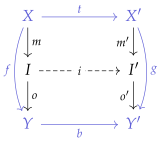
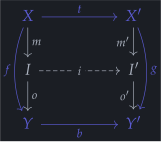
A morphism between splittings lying over a square from to in the arrow category, depicted in blue in the diagram below, is a map between the “middle” objects of the two factorisations making both the top and bottom rectangles commute.
  record
    Interpolant
      {X X' Y Y'} {f : Hom X Y} {g : Hom X' Y'}
      (sq : Homᵃ C f g) (s : Splitting f) (t : Splitting g)
      : Type ℓ where
    field
      map : Hom (s .mid) (t .mid)
      sq₀ : t.left ∘ sq .top ≡ map     ∘ s.left
      sq₁ : t.right ∘ map    ≡ sq .bot ∘ s.right
In the literature on factorisation systems, the total category of this displayed category is identified with the diagram category of composable triples1 in and its projection functor sends each triple to its composite. In a proof assistant, defining this as a displayed category is superior because it lets us define sections of the composition functor— which send each arrow to a factorisation— where the domain and codomain of a factored arrow are definitionally the ones we started with.
  {-# INLINE Interpolant.constructor #-}
  open Interpolant public
unquoteDecl H-Level-Interpolant = declare-record-hlevel 2 H-Level-Interpolant (quote Interpolant)

module _ {o ℓ} {C : Precategory o ℓ} where
  open Precategory C
  open Splitting

  Interpolant-pathp
    : ∀ {X X' Y Y'} {f : Hom X Y} {g : Hom X' Y'} {sq sq' : Homᵃ C f g} {p : sq ≡ sq'} {s : Splitting C f} {t : Splitting C g}
    → {f : Interpolant C sq s t} {g : Interpolant C sq' s t}
    → f .map ≡ g .map
    → PathP (λ i → Interpolant C (p i) s t) f g
  Interpolant-pathp p i .map = p i
  Interpolant-pathp {p = q} {s} {t} {f} {g} p i .sq₀ = is-prop→pathp (λ i → Hom-set _ _ (t .left ∘ q i .top) (p i ∘ s .left)) (f .sq₀) (g .sq₀) i
  Interpolant-pathp {p = q} {s} {t} {f} {g} p i .sq₁ = is-prop→pathp (λ i → Hom-set _ _ (t .right ∘ p i) (q i .bot ∘ s .right)) (f .sq₁) (g .sq₁) i

  instance
    Extensional-Interpolant
      : ∀ {X X' Y Y' ℓr} {f : Hom X Y} {g : Hom X' Y'} {sq : Homᵃ C f g} {s : Splitting C f} {t : Splitting C g}
      → ⦃ _ : Extensional (Hom (s .mid) (t .mid)) ℓr ⦄
      → Extensional (Interpolant C sq s t) ℓr
    Extensional-Interpolant = injection→extensional! Interpolant-pathp auto

module _ {o ℓ} (C : Precategory o ℓ) where
  open Cat.Reasoning C
  Factorisations' : Displayed (Arr C) _ _
  Factorisations' .Ob[_]  (_ , _ , f) = Splitting C f
  Factorisations' .Hom[_]     sq s s' = Interpolant C sq s s'

  Factorisations' .id' = record { sq₀ = id-comm ; sq₁ = id-comm }

  Factorisations' ._∘'_ f g = record where
    map = f .map ∘ g .map
    sq₀ = pulll (f .sq₀) ∙ extendr (g .sq₀)
    sq₁ = pulll (f .sq₁) ∙ extendr (g .sq₁)
The only interesting thing to note about the coherence data here is that
we can reindex Interpolants over
identifications between squares without disturbing the middle map.
  Factorisations' .Hom[_]-set f x y = hlevel 2

  Factorisations' .idr'   f     = Interpolant-pathp (idr _)
  Factorisations' .idl'   f     = Interpolant-pathp (idl _)
  Factorisations' .assoc' f g h = Interpolant-pathp (assoc _ _ _)

  Factorisations' .hom[_] p' f = record where
    map = f .map
    sq₀ = ap₂ _∘_ refl (sym (ap top p')) ∙ f .sq₀
    sq₁ = f .sq₁ ∙ ap₂ _∘_ (ap bot p') refl
  Factorisations' .coh[_] p' f = Interpolant-pathp refl
Functorial factorisations🔗
A (functorial) factorisation on
is a section of Factorisations'. These
naturally assemble into a category.
  Factorisation : Type _
  Factorisation = Section Factorisations'

  Factorisations : Precategory _ _
  Factorisations = Sections Factorisations'
We shall now identify some first properties of functorial factorisations.
module Factorisation {o ℓ} {C : Precategory o ℓ} (fac : Factorisation C) where
  open Cat.Reasoning C
  open Section fac
  private module Arr = Cat.Reasoning (Arr C)

  module _ {X Y : ⌞ C ⌟} (f : Hom X Y) where
    open Splitting (Section.S₀ fac (X , Y , f))
      renaming (mid to Mid₀ ; left to λ→ ; right to ρ→)
      public

  module _ {u v w x : ⌞ C ⌟} {f : Hom u v} {g : Hom w x} (sq : Homᵃ C f g) where
    open Interpolant (Section.S₁ fac sq) using (map) public
Because the morphism-assignment of sections has a pretty dependent
type, we can not immediately reuse the functor reasoning combinators for
functorial factorisations.
However, we can define a functor that assigns each arrow to its midpoint
and re-use the combinators for that functor.
  Mid : Functor (Arr C) C
  Mid = record where
    F₀ x = Mid₀ (x .snd .snd)
    F₁ f = S₁ f .map
    F-id    = apd (λ i → map) S-id
    F-∘ f g = apd (λ i → map) (S-∘ _ _)

  module Mid = Func Mid
  open Mid using (elim ; expand ; weave ; collapse) renaming (⟨_⟩ to adjust) public
Given a functorial factorisation, we can define two endofunctors on
referred to simply as its left and right parts, which
send a morphism
to
and
respectively, while sending a square to either the top or bottom
rectangles in the definition of Interpolant.
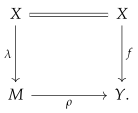
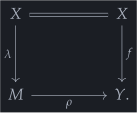
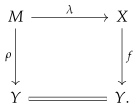
If is a functorial factorisation on splitting an into the left factor functor on is This is naturally made into a copointed endofunctor, with the counit assigning to each arrow the square
If is a functorial factorisation on splitting an into the right factor functor on is This is naturally made into a pointed endofunctor, with the unit assigning to each arrow the square
  L : Functor (Arr C) (Arr C)
  L .F₀ (X , Y , f) = X , Mid₀ f , λ→ f
  L .F₁ {X , Z , f} {X' , Z' , f'} sq = record
    { top = sq .top
    ; bot = S₁ sq .map
    ; com = S₁ sq .sq₀
    }
  L .F-id    = ext (refl ,ₚ Mid.elim refl)
  L .F-∘ f g = ext (refl ,ₚ Mid.expand refl)

  R : Functor (Arr C) (Arr C)
  R .F₀ (X , Y , f) = Mid₀ f , Y , ρ→ f
  R .F₁ {X , Z , f} {X' , Z' , f'} sq = record
    { top = S₁ sq .map
    ; bot = sq .bot
    ; com = S₁ sq .sq₁
    }
  R .F-id    = ext (Mid.elim refl   ,ₚ refl)
  R .F-∘ f g = ext (Mid.expand refl ,ₚ refl)
  open Functor L renaming (F₁ to L₁) using () public
  open Functor R renaming (F₁ to R₁) using () public
These endofunctors are naturally (co)pointed, meaning that the left (resp. right) functor admits a natural transformation to (resp. from) the identity on These transformations send a morphism to a triangle consisting of the complementary part of the factorisation.
  L-ε : L => Id
  L-ε .η (X , Y , f) = record
    { top = id
    ; bot = ρ→ f
    ; com = elimr refl ∙ factors f
    }
  L-ε .is-natural x y f = ext (id-comm-sym ,ₚ S₁ f .sq₁)

  R-η : Id => R
  R-η .η (X , Y , f) = record
    { top = λ→ f
    ; bot = id
    ; com = sym (factors f) ∙ introl refl
    }
  R-η .is-natural x y f = ext (S₁ f .sq₀ ,ₚ id-comm-sym)
-- This is an ugly hack to pretend that morphisms in Factorisations have
-- record fields themselves. Note that we have to choose different names
-- to not clash with those from _=>s_, and that these can not be
-- overloaded.

module
  _ {o ℓ} {C : Precategory o ℓ} {X Y : ⌞ Factorisation C ⌟}
    (f : Factorisations C .Precategory.Hom X Y)
  where
  open Cat.Reasoning C

  private
    module X = Factorisation X
    module Y = Factorisation Y

    record Hack : Type (o ⊔ ℓ) where
      field
        mapᶠᶠ : ∀ {x y} (g : Hom x y) → Hom (X.Mid₀ g) (Y.Mid₀ g)

        sq₀ᶠᶠ : ∀ {x y} (g : Hom x y) → Y.λ→ g ≡ mapᶠᶠ g ∘ X.λ→ g
        sq₁ᶠᶠ : ∀ {x y} (g : Hom x y) → Y.ρ→ g ∘ mapᶠᶠ g ≡ X.ρ→ g

        comᶠᶠ
          : ∀ {w x y z} {g : Hom w x} {h : Hom y z} (i : Homᵃ C g h)
          → mapᶠᶠ h ∘ X .Section.S₁ i .map ≡ Y .Section.S₁ i .map ∘ mapᶠᶠ g

    hack : Hack
    hack = record
      { mapᶠᶠ = λ g → f .map (_ , _ , g) .map
      ; sq₀ᶠᶠ = λ g → intror refl ∙ f .map (_ , _ , g) .sq₀
      ; sq₁ᶠᶠ = λ g → f .map (_ , _ , g) .sq₁ ∙ eliml refl
      ; comᶠᶠ = λ i → apd (λ i → map) (f .com _ _ i)
      }

  open Hack hack public
Note that here denotes the ordinal and not the set with three elements.↩︎